
 A1 Grammar
 Self-study checklist:
Adjectives
 One of the eight parts of speech, adjectives are a type of modifier; that is, they modify or describe nouns in a certain way, letting you know the size, shape, weight, color, nationality, or any of a myriad other possible qualities of nouns.
  An adverb is an invariable word that modifies a verb, an adjective, or another adverb. Adverbs can provide additional information about manner, quantity, frequency, time, or place - they explain when, how, where, how often, or to what degree something is done.
  You can explain what will happen in the near future with the construction aller + infinitive; for example, L'avion va atterrir ici - "The plane is going to land here."
  Aller is one of the most common and useful French verbs and has irregular conjugations in most tenses and moods. Aller literally means "to go" and is used to create the near future.
  In English, you can only answer yes / no questions with variations on the themes of yes, no, and I don't know. French, however, has another possibility: yes in response to no.
  The French verb arriver usually means "to arrive" or "to happen." It's a regular -er verb that requires être as its auxiliary verb in compound tenses/moods.
  One of the eight parts of speech, an article is a word that modifies a noun in a particular way, by stating whether the noun is specific, unspecific, or partial. There are three types of French articles and they all agree in gender and number with the nouns they modify.
 The preposition avec is used similarly to its English equivalent "with," but with a few differences.
  Avoir is one of the two most important French verbs and has irregular conjugations in just about every tense and mood. Avoir literally means "to have" but also serves an an auxiliary verb and is found in many idiomatic expressions.
 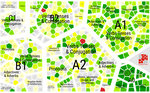 Visualize your French progress with the PwLF Brainmap. The color-coded overview shows your strengths and weaknesses by level and topic, and you can drill down to access individual lessons. Prove your mastery by turning the whole map green!
 The regular -er French verb chercher generally means "to look for" something or "to try to" do something.
  Contractions occur when two words are combined into one, sometimes with a distinctly different spelling. In English, contractions like "won't" are optional and indicate informality. In French, however, contractions are required, regardless of the register you're speaking or writing in.
  The preposition dans usually means "in," but as always there are exceptions. Dans can't be followed directly by a noun - it's always followed by some kind of determiner, such as an article or possessive adjective.
  If you ever write letters, make plans, or request appointments, this lesson will be invaluable. There are a few little formulas to memorize in French, but otherwise, dates are very easy to talk about.
  The French preposition de is generally summarized as "of, from, or about," but it has quite a few more meanings and uses than that.
  The French definite articles (le, la, l', les) indicate either a particular noun or, contrarily, the general sense of a noun. They're used similarly to their English counterpart "the," but there are many instances where a definite article is required in French but not English.
  In the present tense, the irregular -ir verbs devoir (must), pouvoir (can), and vouloir (want) are conjugated according to a similar pattern.
  In the present tense, the irregular -re verbs dire (to say, tell), écrire (to write), and lire (to read) are conjugated mostly according to the same pattern.
  Dire is one of the most common and useful French verbs and has irregular conjugations. It literally means "to say" or "to tell," and is also found in many idiomatic expressions.
  In the present tense, the irregular -ir verbs dormir (to sleep), partir (to leave), and sortir (to go out) are conjugated according to the same pattern.
 Être is one of the two most important French verbs. It literally means "to be," but also serves as an auxiliary verb and is the key to the passive voice.
 One of the most common and useful French verbs, faire literally means "to do" or "to make" but it's also found in many idiomatic expressions and is the key to the causative construction.
 The aptly named indefinite article (un, une, des) indicates an unspecific or unidentified countable noun.
  When you start learning French, it's not just French vocabulary you have to get used to - you're also introduced to a whole new world of grammatical terms. For many students, one of the most daunting of these is verb conjugations. Just what is a verb conjugation and what does it mean to conjugate a verb?
  Verbs are action words that express the action or state of being of a sentence. French verbs have up to six different conjugations for each tense and mood.
 Negative adverbs turn affirmative statements and questions into negative statements and questions. The most common English negative adverb is the word "not," but French is a little more complicated - quelle surprise ! ;-)
  One of the eight parts of speech, a noun is commonly defined as "a person, place, or thing." If that seems vague, that's because it is.
  The partitive article (du, de la, de l', des) refers to an unspecified quantity of food, liquid, or some other uncountable noun. English has no equivalent article - the partitive is usually translated by the adjectives "some" or "any," or may be left out entirely.
  Prepositions are short but essential words which are placed after a verb, noun, or adjective in order to indicate a relationship between that word and the noun or pronoun that follows.
  The French present tense, also known as the present indicative, is fairly similar to the English simple present, but there are some key differences.
  Progress with Lawless French is an adaptive, test-driven French learning system that will help you learn more efficiently with personalized kwizzes, writing challenges, and dictées.
  Take your Progress with Lawless French account to the next level with these super study lists that bring together all the lessons on a particular grammar topic.
  Reflexive pronouns reiterate the subject, which may seem redundant, but in fact serves an important purpose: it indicates that the subject of the verb is performing that action on itself.
  There are several thousand verbs that end in -er, the largest category of regular French verbs. To conjugate them, remove the infinitive ending and then add the appropriate -er verb ending.
  The preposition sans is used similarly to its English equivalent "without," but not without a few differences.
  French verbs that end in -cer or -ger require a small spelling change in certain conjugations. For the most part, these verbs are conjugated just like regular -er verbs, other than a little problem in some conjugations that must be corrected for reasons of pronunciation. It's easy enough to do, once you understand why and how.
  Stem-changing verbs, also known as "shoe verbs" or "boot verbs," take the same conjugation endings as regular -er verbs, but have two different verb stems depending on the grammatical person the verb is conjugated for.
  Subject pronouns indicate who or what is performing the action of a verb. French has a total of six grammatical persons, each of which has at least one subject pronoun.
  Knowing how to tell time is essential for traveling, meeting up with friends, making appointments, and getting to work or school on time. Once you learn these formulas, you'll never have an excuse to be late again!
 One of the tricky aspects of French is that there are two different words for you, tu and vous, and very complicated rules about when to use which one. Choosing the right subject pronoun is important not just from a grammatical point of view, but also for reasons of etiquette. You can read more about that in my
  The distinction between tu and vous is one of the most confounding aspects of French, and one of the most basic. The influence it has on verb conjugations, adjectives, and pronouns is considerable, but more than that, the choice of tu or vous is a matter of etiquette.
  Venir is one of the most common and useful French verbs and has irregular conjugations in most tenses and moods. Venir literally means "to come" and is used to create the recent past.
  You can explain what happened in the recent past with the construction venir de + infinitive; for example, Je viens de terminer ce puzzle - "I (have) just finished this puzzle."
  This free website is created with love and a great deal of work. If you love it, please consider making a
 Unlike other French suffixes, -ci does not create new words, but rather adds additional meaning to the nouns and pronouns it's attached to.

